In this post, I live blog my Spanish Learning Journey so that I can look back and see my progress, but also so that I can be helpful to anyone else who may share my learning style and context! This may be especially useful if you:
- Are learning Spanish from scratch (though many of the resources I link to also include resources for other languages)
- Value flexible, self-paced learning
- Want a focus on spoken conversation (as opposed to written communication)
Finally, while I document my whole journey, feel free to skip directly to Year Nine when I finally start learning Spanish in earnest.
Enjoy!
My journey as of March 17th, 2026
Year One
March 2008: I sign up for LiveMocha. I make little to no progress and the site no longer exists.
Year Two
August 2009: I take a Spanish class at Princeton, earn an A, but never learn the skills I need to hold a conversation in Spanish.
Year Three
Nothing that I can remember.
Year Four
June 2011: I had hoped to do a summer immersion program in Guatemala but put that plan off for personal reasons.
Year Five
Nothing that I can remember.
Year Six
Nothing that I can remember.
Year Seven
May 2015: I take The Mimic Method’s free course an how to pronounce Spanish sounds. I’m hooked but not yet ready to purchase the full program.
Year Eight
Nothing that I can remember.
Year Nine
May 2017: I move to Jackson Heights, Queens, where I walk into a Mexican or Argentinian restaurant and my waiters only speak Spanish. My desire to learn Spanish comes back with a vengeance.
June 2017: I’m eating lunch with some new friends at a Mexican Restaurant where I need to order in Spanish. When I tell my friend that I had studied abroad in Italy, he said, “No wonder you pronounce Spanish like you’re saying Italian!” The reminder motivates me to start taking The Mimic Method ($194), a learn by ear program that has you perfect an accent BEFORE learning to understand or speak through memorizing Spanish songs. I love The Mimic Method because I feel infinitely more confident in my ability to speak, now. A great bonus is that I’ve also added Pies Descalzos by Shakira to my karaoke list! To complement my work with The Mimic Method, I decide to start going through Rocket Languages ($149.93) for guided lessons. I love Rocket Languages because I find it more interesting to memorize vocabulary in the context of a fun dialogue than out of context. It also uses the Spanish spoken in Latin America as opposed to in Spain.
August 2017: I receive my very first compliment by a native Spanish speaker!
October 2017: I read The Telenovela Method ($7.99), which teaches me how to learn Spanish directly from Spanish source material. I start working on Mi Vida Loca based on the book’s recommendation. Mi Vida Loca is a fun mystery adventure show that also covers basic learning points for absolute beginners. Most importantly, it has both Spanish and English subtitles for everything. I slowly work my way through the adventure, adding vocabulary to Studies ($29.99), my flashcards application, as I go. Once in a while, I review my Rocket Language and Mi Vida Loca video lessons by listening to the dialogue without any of the captions to see if I understand everything that’s being said. Something I learned from The Telenovela Method is that listening comprehension is the most important skill in language learning and I agree! [UPDATE: I no longer use Studies and do not recommend it. Instead, switch to Anki!]
November 2017: I sign up for Fluent in 3 Month’s email course, Start Speaking Your Target Language in the Next 7 Days. Part of the course linked to a video of Benny, the course creator, having a Skype call with a native speaker just one week after he starts learning the language. Watching this video on how to have your first conversation in another language starts getting me over the fear of actually talking to people. I try to constantly remind myself that the fastest way to learn is to make mistakes, and that the more mistakes I make, the better! As part of the course, I write an intro script and get feedback on it through italki. italki is an amazing site where volunteer native speakers correct writing by language learners.
As for my progress in Rocket Languages, I am on the Numbers lesson but am having trouble with fluency. I download a random number generator iPhone app so that I can isolate number practice. My goal is to be able to read any whole number in Spanish immediately, without translating it from English.
I start reading How to Learn and Memorize Spanish Vocabulary ($2.99) and download its worksheets + video course ($7.00) on how to make memory palaces for that Spanish vocabulary. Memorization has been a great weakness of mine and I decide that now’s the perfect time to fix that. [UPDATE: I found that memory palaces don’t work for me for language learning, but I did stumble across the same author’s course on using memory palaces to memorize names and faces, and will be tackling that, soon!]
I also start reading Fluent Forever; How to Learn Any Language Fast and Never Forget It ($14.99) and download the author’s pronunciation guide ($12). The three most important takeaways for me from Fluent Forever are:
(1) Speaking fluently is like a game of Taboo. I find this to be such a wonderful concept because one of the things that’s hardest for me is getting over my fear of making mistakes. If I just think of myself as playing Taboo the whole time I’m speaking Spanish, I’m a lot more forgiving of myself. After all, Taboo’s a great deal of fun!
(2) Use only your target language + photos and audio on your review materials. This way you aren’t translating, you’re immediately thinking in your target language. I went through and changed all of my flashcards to reflect this principle, and am very happy about the change.
(3) Make multiple flashcards per sentence you’re studying to isolate what you’re studying. The grammar in a sentence is made up of three parts at its core: new words, new word forms, and new sounds. So, you can make different flashcards targeting each skill for the same sentence! See examples of these flashcards here.
Year Ten
January 2018: My studying goes into overdrive. I’m talking ~4 hours/day. See, I’m prepping for my upcoming language learning trip to Costa Rica where I’ll be placed in a Spanish class level based on an exam and oral interview. I do not want to be put in a beginner-beginner class. Part of my studying includes a new program, Unlimited Spanish ($97). I love this program. It takes a call and response approach to language learning so that I’m building automaticity in my speaking skills. It also includes Point of View lessons that tell the same exact stories but in different tenses. This is useful because I’m already so familiar with the story and the vocabulary that I can focus 100% on just learning how the verbs conjugate in the different tenses. I finish Mi Vida Loca as well. Three weeks of intensive studying later and it’s go time.
Upon arriving in Costa Rica I discover: Yes, I can understand and speak Spanish, at least enough to get by. My self-studying had totally paid off! I spend my first week at CPI Monteverde, a Spanish School in Costa Rica ($600 [a gift from my lovely novio]). What an adventure! In the mornings I got to learn all about irregular verbs in the imperfect and preterite, por vs. para, and gerunds. In the afternoons, I got to go canyoning, and ziplining, all while returning home to a delicious home-cooked meal with a wonderful host family. I highly recommend the program for anyone who wants to visit Costa Rica. The entire experience was both effective and delightful. The next week was vacation vacation, which I spent kayaking, paddle boarding, surfing, and reading. I did learn a lot of humility, however, by discovering that although I could have conversations with adults, I was totally lost when my ten-year-old host brother started launching into his stories. I’ve clearly got a long way to go.
February 2018: I continue studying with Rocket Languages, Unlimited Spanish, and Fluent Forever. I find the trifecta perfect for me! My current vocabulary count is 829 words. I want to hit 1000 by Spring.
March 2018: A fellow subway passenger notices that I’m studying Spanish on the train. I turn to him and he says, “Hi! Do you speak Spanish?” I respond, “Sí, un poco.” We then go on to have a very nice conversation in Spanish. I learned that he’s from El Salvador, has lived in New York City for 10 years, and has children whom he only speaks to in Spanish at home so they will know the language fluently. He also complimented me on my pronunciation and told me to watch lots of movies in Spanish. When I asked for recommendations for little kids, one of his answers was Despicable Me. In my head, I was like, “Hell, yeah!”
Also… on March 12th I hit my 1000th vocabulary word! 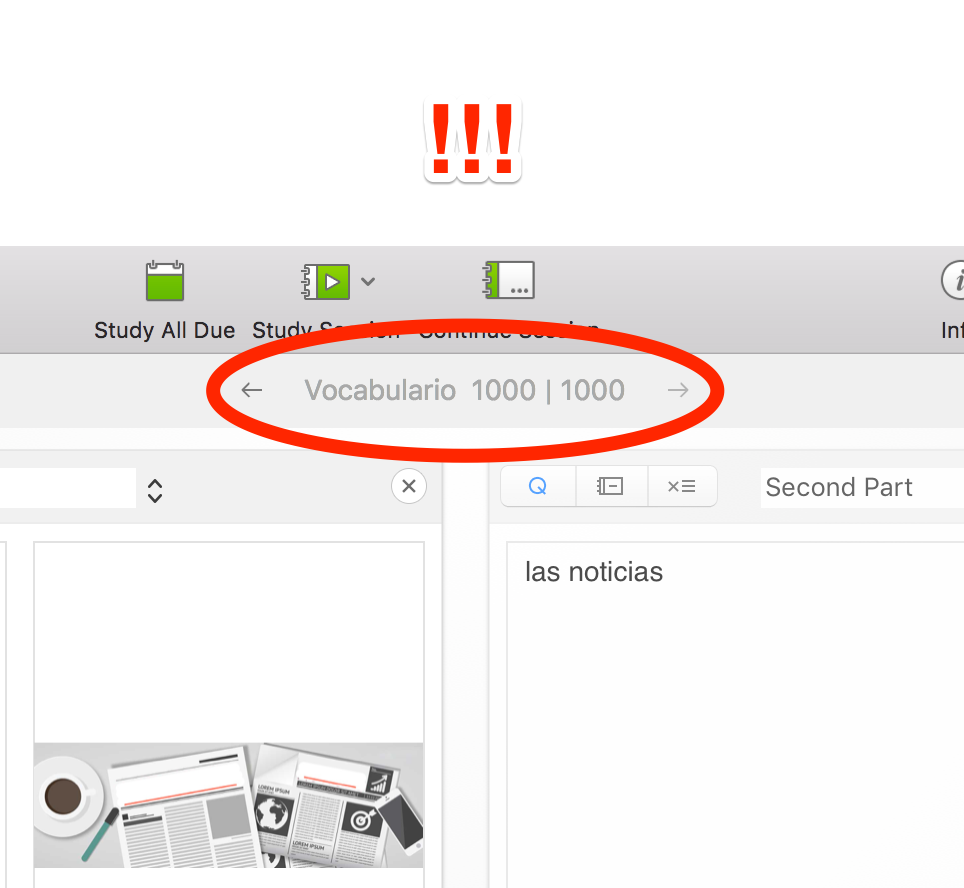
May 2018: I finally finished Fluent Forever’s First 625 Words!
Year 11
All of 2019: I’m still learning Spanish by following the Fluent Forever method and using Rocket Languages as my base curriculum. I focus on phrases that I would use just living in my neighborhood. Phrases like
- Learning
- Si cometo un error, por favor dímelo.
- ¿cómo se dice?
- Conversations
- ¡que tengas un buen día!
- tengo que ir corriendo
- Restaurants
- ¿Para llevar o para aquí?
- La cuenta, por favor.
- ¿Qué me recomienda?
- Work
- la organización sin fines de lucro
- muchos padres sólo hablan español
My favorite image is for “Si cometo un error, por favor dímelo.”

Year 12
February 2020: We all know what happened in 2020 – the world shut down because of COVID-19. All my energy this year is now going into mutual aid organizing and the nonprofit I cofounded: Youth Power Coalition. My productivity systems broke down. Emails go unanswered, my todos management process falls apart, I fall out of touch with many friends, and I stop doing my daily Spanish practice.
August 2020: I volunteer to canvas for the Census because my neighborhoods are often undercounted. I use more Spanish than English or Chinese as I help people fill it out.
Years 13 – 16
All of 2021-2024: Nothing that I can remember. Again, recovering from the year everything shut down.
Year 17
May 2025: I connect once again with my desire to learn Spanish. I’m now a member of my Community Board, an independent government agency whose purpose is to connect residents with government and elected officials. Because many people in my community district speak only Spanish, I feel a responsibility to learn again, to get to the point where I can have full conversations in Spanish and be the best possible advocate I can be for our community. Somehow, I stumble across a new resource, Dreaming Spanish, that has completely changed my relationship with how to learn Spanish.
According to the creators of Dreaming Spanish, learning by immersion is enough. No grammar study. No flashcards. Instead, we start by just listening, listening, and listening more. However, what we listen to matters, in that what we listen to must be comprehensible. Here are select quotes from an explanation by Pablo Roman Humanes, the founder of Dreaming Spanish and author of The OG Immersion Method:
The concept of comprehensible input is fundamental for understanding how we acquire a language. Since Dr. Stephen Krashen introduced this concept as part of his Input Hypothesis, more and more research has piled up showing that receiving comprehensible input is not only necessary for acquiring a language (both first and second), but it is also sufficient. More and more research is also showing that it’s not only necessary and sufficient, but also faster and gives better results.
What is “Comprehensible Input”, though? We are receiving comprehensible input when we understand messages. The “input” part means that we are listening or reading. Only listening or reading (or watching in the case of sign languages) is input. Speaking, writing, and doing exercises is not input. The “comprehensible” part, means that what we are listening to or reading is understandable to us. This doesn’t mean that we understand every word or every grammar point in the input, but that we understand enough to be able to figure out the rest thanks to context. When we receive comprehensible input, the conditions are met for our brain to be able to use its natural ability to acquire language, without having to do anything else. There’s no need to study, review vocabulary, or practice anything. Watching and reading itself results in acquisition. Research also keeps showing that this ability to acquire language remains active even as an adult, and that we can benefit a lot by imitating the way children learn their first language.
Dreaming, Dreaming Spanish’s parent company, also has this roadmap for acquiring languages that ties the number of input hours with an estimate of where a learner’s skill level would be and what they should be doing to continue improving.
So what does this look like for me? First, I decided to start tracking my input hours from 0. While I was above the super beginner level when I started, I figured it wouldn’t hurt to start easy. Also, I’m someone who is motivated by completing levels, so I wanted to “earn” every hour. Next, I’m following their roadmap’s recommendation to not speaking until at least 600 hours (maybe even 1000 hours). While I have fewer concerns about the impact of speaking early on my pronunciation (because I’ve studied pronunciation in isolation and have always gotten good feedback on it), I do think that waiting would help me with sounding natural. If I started now, I think I would bake in some bad habits like directly transposing English sentence structure to Spanish. Finally, I joined the Dreaming Spanish community on Reddit. I read a post there once where someone said that the social aspect of Dreaming Spanish was part of what keeps them motivated, and I experience that as well.
August 2025: My first perfect month where I listened to Spanish at least 30 minutes a day for a whole month.
November 2025: The beginning of a period of burnout. I listened to 30 minutes a day for 4 days in November and 6 days in December.
Year 18
January 2026: I pick up listening to Spanish almost every day again mid-January.
March 2026: I’ve now been doing Dreaming Spanish for 217 days and am at 249 hours. That means that I’ve been listening to, on average, about 1 hour of Spanish a day.
Things I’m currently listening to include
- Dreaming Spanish videos at a 45 difficulty level
- Podcasts for Spanish learners including Chill Spanish and Español a la mexicana
- Dubbed kids shows including Daniel Tiger, Weather Hunters, Carl the Collector, and Pororo the Little Penguin
- Native media on Youtube on subjects that I’m very familiar with like rock climbing, skiing, and Python
- Crosstalk with Spanish speakers where they speak in Spanish and I speak in English
I have moments where I feel “Wow, I’ve improved so much!”, like some months back when Daniel Tiger went from impossible to understand because of the high voices and songs to now perfectly comprehensible, but there are also moments where I think, “Is this even working?” I also have moments where I get bored, so I need to look for yet another input source. I read a couple of books for toddles (like Hello Feet), just to change things up temporarily, even though the roadmap doesn’t recommend reading until at least 600 hours. Finally, I look at the estimated days I’ll need to reach each level if I listen for 30 minutes a day (the achievable goal that I’ve set for myself), and I think, “This is a really long time.” To get to those 600 hours, for example, will take another 701 days or 2 years. However, I’m telling myself to trust the process, to enjoy the journey, and to celebrate little wins along the way. When I have the interest, I also listen to more than 30 minutes a day to get myself to those target hours a little quicker. I guess it’s a wait and see!
My Learnings to Date
- I became infinitely more motivated when I was in an environment where learning Spanish would be put to real use.
- I needed to (and still need to) feel comfortable speaking from day one. Having scripts and lots of examples help get me started. [Update: I’ve moved to a new method where we actually don’t speak until having listened to at least 600 hours of comprehensible input. What I learned about how to be comfortable speaking continues to help, though, as I trust that I’ll be ready when returning to speaking practice later.]
- Learning how to learn is a skill! I’m so glad to be able to continue learning how to learn for myself.
- You know you’re fluent conversationally when you can understand a ten-year-old child speaking really, really fast.
- Community is important.

 Deborah Chang
2 Comments Add yours